Elevating Digital Interfaces with Isometric 3D Weather Icons
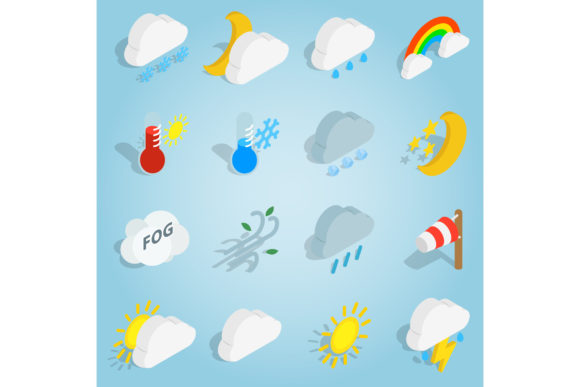
In the rapidly evolving landscape of user interface design, the demand for visuals that offer depth, personality, and clarity has never been higher. Designers are constantly searching for assets that break away from the flat, two-dimensional norms of the past decade while maintaining the usability required for modern applications. This is where a high-quality Weather Set Icons collection rendered in an Isometric 3d Style becomes an invaluable resource. These assets do more than just indicate rain or shine; they add a layer of tactile realism and artistic flair that can define the entire aesthetic of a web or mobile project.
The shift toward isometric illustration represents a significant trend in digital product design. Unlike traditional perspective drawings that vanish into a distant point, isometric projections maintain parallel lines, creating a unique "fake 3D" look that is both geometrically consistent and visually engaging. When applied to meteorological elements, this style transforms mundane data points into charming, miniature dioramas. A cloud isn't just a grey shape; it becomes a fluffy, volumetric object casting soft shadows. A sun isn't merely a circle; it radiates with dimensional rays that suggest warmth and presence.
The Power of Dimension in User Experience
Integrating an Isometric weather icons set into your workflow offers immediate benefits regarding user engagement. Human eyes are naturally drawn to objects that possess depth and lighting cues. By utilizing universal weather icons designed with these characteristics, you guide the user's attention more effectively than with flat alternatives. This is particularly crucial in dashboard designs, home screen widgets, or travel apps where weather information needs to be digestible at a glance.
Consider the psychological impact of these visuals. A storm depicted with jagged, dark isometric lightning bolts and heavy, layered rain clouds conveys urgency and severity more potently than a simple line drawing. Conversely, a sunny day represented by a bright, multi-layered sun with soft gradients evokes a sense of calm and positivity. These universal weather icons serve as emotional anchors within an application, subtly influencing how a user feels about the information they are consuming.
Furthermore, the versatility of these assets cannot be overstated. Because they are created as vector illustrations, they scale infinitely without losing quality. Whether you are designing a massive billboard display or a tiny notification icon for a smartwatch, the crisp edges and clean geometry of the isometric style remain intact. This scalability is essential for responsive web design, where elements must adapt fluidly across desktops, tablets, and various mobile screen sizes.
Technical Flexibility and File Formats
For professional designers, the utility of an asset pack is often determined by the file formats provided. A comprehensive collection should include JPG, EPS, AI, PSD, and PNG files to ensure compatibility with every stage of the design process. Each format serves a specific purpose in the workflow:
- AI (Adobe Illustrator): The master file for vector editing. This allows designers to modify colors, reshape elements, or extract specific parts of the Weather Set Icons to create custom variations. It is the ideal starting point for branding adjustments.
- EPS: A universal vector format compatible with a wide range of graphic design software beyond Adobe, ensuring that teams using different tools can still access the high-quality vectors.
- PSD (Photoshop): Essential for raster-based workflows. These files often come with layers intact, allowing for advanced shadow manipulation, texture overlays, and blending mode experiments directly within Photoshop.
- PNG: The go-to format for implementation. With transparent backgrounds, these ready-to-use images can be dropped straight into code or design mockups without needing further processing.
- JPG: Useful for previews, documentation, or situations where file size is a critical constraint and transparency is not required.
Having access to this diverse array of formats means that the Isometric 3d Style assets can fit seamlessly into agile development cycles. Developers can grab the PNGs for immediate testing, while UI designers can tweak the AI files to match a client's specific color palette before handing off the final assets.
Applications Across Industries
The application of an Isometric weather icons set extends far beyond standard weather forecasting apps. In the realm of e-commerce, these icons can enhance logistics trackers, indicating delays due to snow or storms with visually distinct markers. Travel and hospitality platforms utilize them to showcase destination climates, making vacation packages more appealing through vibrant, sunny imagery.
Gaming interfaces also benefit significantly from this aesthetic. Many modern mobile games adopt an isometric viewpoint for their gameplay; using matching isometric weather effects creates a cohesive visual language that immerses the player deeper into the game world. Similarly, smart home interfaces use these universal weather icons to provide homeowners with quick environmental updates, blending functionality with a sleek, modern interior design aesthetic.
Even in data visualization and infographics, these icons serve as powerful storytelling tools. When presenting climate change data or seasonal sales trends, replacing generic symbols with detailed, three-dimensional illustrations can make the data more relatable and memorable for the audience. The depth provided by the isometric perspective helps differentiate between overlapping data points, improving readability in complex charts.
Choosing the Right Assets for Your Project
When selecting a Weather Set Icons package, there are several factors to consider to ensure it aligns with your project goals. First, evaluate the consistency of the Isometric 3d Style. All icons in the set should share the same light source, angle of projection, and level of detail. Inconsistencies here can jar the user and make the interface feel unpolished.
Secondly, consider the color palette. While some projects require realistic colors, others may benefit from a stylized, pastel, or monochromatic approach. A good vector illustration set often provides base colors that are easy to recolor via the AI or EPS files. Look for sets that separate the shading and highlighting onto different layers, as this grants maximum control over the final look.
Another critical consideration is the completeness of the set. A truly universal weather icons collection should cover not just the basics like sun, cloud, and rain, but also nuanced conditions such as sleet, fog, thunderstorms, wind gusts, and varying degrees of cloud cover. Missing icons can force designers to mix and match from different sources, which rarely results in a unified visual identity.
Future-Proofing Your Design System
As screen resolutions continue to increase with the advent of Retina displays and 4K monitors, the reliance on scalable vector graphics becomes non-negotiable. Raster images that look acceptable on older screens often appear pixelated and amateurish on new devices. By investing in a high-quality Isometric weather icons set delivered in vector formats like AI and EPS, you future-proof your design system against hardware advancements.
Moreover, the trend toward micro-interactions in UI design pairs exceptionally well with isometric assets. Because these icons have defined volumes and separate elements (like rain drops falling or clouds drifting), they are perfect candidates for animation. Developers can easily animate individual layers exported from the PSD or AI files to create dynamic weather effects that react to user touch or real-time data changes.
In conclusion, the integration of Weather Set Icons crafted in an Isometric 3d Style is more than just a cosmetic upgrade; it is a strategic design decision. It bridges the gap between functional data presentation and artistic expression. Whether you are building a next-generation mobile app, a responsive website, or an interactive kiosk, these universal weather icons provide the depth, clarity, and versatility needed to create standout digital experiences. By leveraging the full potential of formats like JPG, EPS, AI, PSD, and PNG, designers can ensure their work remains robust, adaptable, and visually compelling in an increasingly competitive digital marketplace.