Streamlining Visual Logistics with a Warehouse Shelves Flat Color Object Set
In the fast-paced world of digital design, clarity is king. Whether you are building an infographic for a logistics company, animating a supply chain process for a corporate presentation, or designing a user interface for an inventory management app, the visual elements you choose can make or break the user experience. This is where a specialized Warehouse Shelves Flat Color Object Set becomes an invaluable asset. Unlike complex 3D renders that can clutter a screen or distract from key data, flat color illustrations offer a clean, modern aesthetic that prioritizes readability and speed.
This article explores the practical applications, benefits, and strategic considerations of utilizing a Warehouse shelves flat color vector object set featuring cardboard boxes and merchandise. We will delve into why this specific style resonates with modern audiences and how it can be integrated into various professional workflows.
The Power of Flat Design in Industrial Contexts
Historically, industrial themes like warehousing and distribution were depicted using gritty, realistic photography or highly detailed technical drawings. While these have their place, they often fail to translate well onto smaller screens or within quick-loading web graphics. The shift toward flat design has revolutionized how we visualize complex systems. By stripping away unnecessary textures, shadows, and gradients, a flat color object set allows the viewer to focus immediately on the structure and function of the subject matter.
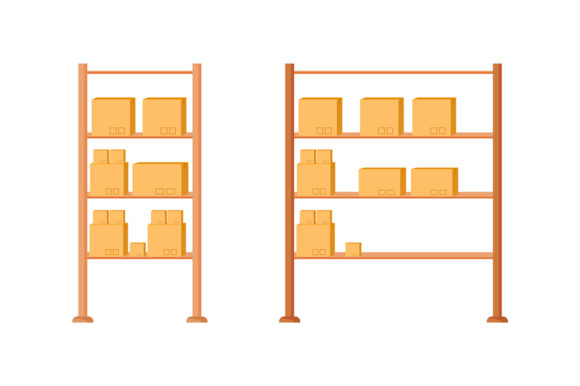
A high-quality Warehouse Shelves Flat Color Object Set typically includes modular components: upright frames, horizontal beams, and various types of stored goods, such as cardboard boxes on shelf for distribution. These elements are designed to be isolated, meaning they can be easily rearranged, recolored, or animated without background interference. This isolation is crucial for creators who need to adapt assets for different brand guidelines or specific layout constraints.
Key Characteristics of Effective Vector Assets
When evaluating a collection for your next project, it is essential to understand what makes a vector set truly versatile. The best collections are not just static images; they are building blocks for storytelling. Here are the core features to look for:
- Scalability: Since the assets are vector-based (often provided in EPS format), they can be scaled from a tiny icon on a mobile device to a massive billboard without losing resolution or becoming pixelated.
- Modularity: The set should allow you to construct shelves of varying heights and widths. Can you add more levels? Can you swap out a standard box for a pallet?
- Color Consistency: A cohesive palette ensures that when you combine different elements, they look like they belong in the same universe. Flat color sets usually employ a limited, harmonious range of hues.
- Animation Readiness: For motion designers, the separation of layers is vital. A good set ensures that individual boxes or shelf units can be keyed frame-by-frame without affecting the rest of the illustration.
Real-World Applications for Creators and Businesses
The utility of a Merchandise for shipment isolated cartoon illustration extends far beyond simple decoration. It serves as a functional tool for communication across multiple industries. Let's examine how different professionals leverage these assets.
1. Logistics and Supply Chain Visualization
For business owners and logistics managers, explaining the flow of goods can be challenging. A static paragraph of text rarely captures the dynamics of a distribution center. By using a Warehouse Shelves Flat Color Object Set, companies can create clear, step-by-step infographics. These visuals can illustrate how products move from receiving docks to storage racks, and finally to shipping zones. The simplicity of the flat style ensures that stakeholders grasp the process instantly, reducing miscommunication and training time.
2. Web Development and UI/UX Design
In the realm of web graphic design, load times and responsiveness are critical. Heavy photographic backgrounds can slow down a website, negatively impacting SEO and user retention. Flat color vectors are lightweight code-wise and render instantly on all devices. Developers can use these assets to create engaging "empty states" for inventory apps (e.g., showing an empty shelf when stock is zero) or to decorate landing pages for SaaS platforms that manage warehouse operations.
3. Educational Content and E-Learning
Educators creating courses on supply chain management or business operations benefit greatly from these illustrations. The cartoon illustration style is approachable and less intimidating than technical schematics. It allows instructors to highlight specific safety protocols, such as proper stacking techniques for cardboard boxes, or to demonstrate the organization of merchandise for shipment in a way that is visually engaging for students.
Navigating File Formats: EPS vs. JPG
Most professional collections, including the Warehouse Shelves Flat Color Object Set, come in a ZIP file containing both EPS and JPG formats. Understanding the distinction between these two is vital for maximizing the value of your purchase.
The JPG files are raster images. They are ready-to-use for quick mockups, social media posts, or presentations where editing is not required. They are universally compatible and easy to drag and drop into documents. However, they have a fixed resolution. If you stretch them too far, they will blur.
The EPS (Encapsulated PostScript) files are the powerhouse of the collection. As vector files, they contain mathematical paths rather than pixels. This means you can open them in software like Adobe Illustrator or CorelDRAW to change colors, resize elements infinitely, and separate layers for animation. For any serious design work, the EPS file is the primary source you should be working with.
Strategic Considerations and Limitations
While flat design is incredibly effective, it is not a one-size-fits-all solution. When deciding to implement a Warehouse shelves flat color vector object set, consider the tone of your project. If you are selling high-end luxury real estate for industrial parks, a hyper-realistic photograph might convey prestige better than a cartoon-style illustration. Flat design leans towards efficiency, friendliness, and modernity.
Additionally, context matters. When using isolated objects, ensure there is sufficient contrast against your background. A common mistake is placing light-colored flat icons on a white background, rendering them invisible. Always test your compositions in grayscale to ensure the shapes and forms communicate clearly even without color cues.
Evaluating Suitability for Your Project
Before integrating these assets, ask yourself the following questions:
- Does the style match my brand identity? If your brand is strictly corporate and traditional, a "cartoon" style might need to be adjusted to be more geometric and severe.
- Do I need animation? If yes, verify that the EPS file has grouped elements logically (e.g., each box is a separate group) to save hours of manual ungrouping later.
- Is the color palette flexible? Can you easily recolor the shelves to match your company's branding, or are the colors baked into complex gradients that are hard to edit?
Conclusion: Enhancing Communication Through Clarity
In an era where attention spans are short and information overload is common, the ability to communicate complex ideas simply is a superpower. A Warehouse Shelves Flat Color Object Set offers more than just pretty pictures; it provides a framework for clear, effective visual storytelling. Whether you are a graphic designer crafting the next big logistics campaign, a developer building an inventory tool, or a business owner trying to explain your distribution process, these assets bridge the gap between abstract concepts and concrete understanding.
By leveraging the scalability of vectors, the clarity of flat design, and the modularity of isolated objects like cardboard boxes on shelf for distribution, creators can produce work that is not only aesthetically pleasing but also deeply functional. As you explore the possibilities of these digital tools, remember that the best design is often the one that goes unnoticed because it works so seamlessly, guiding the user effortlessly through the information at hand.