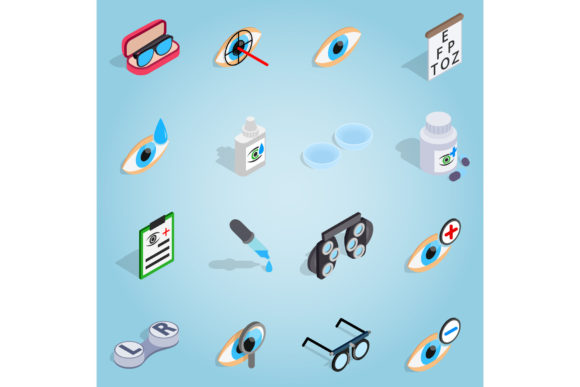
Visualizing Eye Care: The Power of Isometric 3D Optometry Icons in Modern Design
The landscape of digital healthcare communication has shifted dramatically over the last decade. Where once text-heavy brochures and flat, two-dimensional diagrams dominated patient education materials, today's interfaces demand clarity, engagement, and visual sophistication. At the forefront of this transformation is the Optometry Set Icons, Isometric 3d Style. This specific design approach merges the technical precision required for medical illustration with the aesthetic depth of isometric projection, creating a universal language for eye care professionals, app developers, and educators alike.
Isometric design offers a unique perspective that simulates three-dimensional space on a two-dimensional surface without the distortion of perspective vanishing points. When applied to optometry elements—such as phoropters, slit lamps, eyeglass frames, and contact lens cases—the result is an illustration style that feels tangible and interactive. For web and mobile UI designers, utilizing a comprehensive set of these vector illustrations provides a cohesive visual identity that enhances user experience while maintaining professional credibility.
The Strategic Advantage of Isometric Projection in Medical UI
The decision to adopt an isometric style for optometry icons is not merely aesthetic; it is functional. In the context of User Interface (UI) and User Experience (UX) design, clarity is paramount. Traditional flat icons can sometimes appear too abstract, leaving users unsure of the specific function or object represented. Conversely, hyper-realistic photographs can clutter an interface and slow down loading times. The Isometric 3d Style strikes a perfect balance.
By presenting optometry tools and concepts in a 3D-like format, designers provide immediate visual cues about the object's form and function. A user looking at an isometric icon of an autorefractor instantly recognizes the machine's bulk, lenses, and chin rest, distinguishing it from a simple trial frame. This reduces cognitive load, allowing patients and practitioners to navigate digital platforms more efficiently. Furthermore, the depth provided by isometric projection adds a layer of modernity and polish to websites and applications, signaling that the brand is up-to-date with current design trends.
Another significant advantage lies in scalability. Because these assets are typically available as vector illustrations in formats like AI and EPS, they can be resized infinitely without losing quality. Whether displayed on a massive clinic lobby screen or a small smartwatch notification, the crisp lines and defined angles of the isometric optometry set remain sharp. This versatility makes them ideal for responsive web design, where content must adapt seamlessly across desktops, tablets, and mobile devices.
Essential Elements Within a Comprehensive Optometry Icon Set
A robust Universal optometry icons collection goes beyond the basics. To truly serve the diverse needs of the industry, a high-quality set must encompass a wide array of equipment, procedures, and corrective solutions. When evaluating or creating such a set, one should look for coverage in several key categories.
- Diagnostic Equipment: Detailed representations of slit lamps, tonometers, and fundus cameras are essential for explaining examination processes to patients. Isometric rendering helps visualize how these machines interact with the patient.
- Corrective Lenses and Frames: A variety of eyeglass styles, from reading glasses to safety goggles, along with contact lens blister packs and solution bottles, are crucial for e-commerce sections of optical retail sites.
- Testing Tools: Items like the Snellen chart, occluders, and trial lens kits are fundamental for educational content regarding vision testing protocols.
- Anatomical References: Simplified isometric models of the human eye, highlighting the cornea, lens, and retina, aid in explaining conditions like myopia, hyperopia, and astigmatism.
Having access to these elements in multiple file formats ensures flexibility for different stages of the design workflow. For instance, a graphic designer might start with the PSD files to manipulate layers and lighting effects in Photoshop, while a web developer might prefer the PNG versions with transparent backgrounds for immediate implementation. For those needing to edit the vector paths themselves, the AI and EPS formats are indispensable.
Applications Across Diverse Professional Sectors
The utility of an Optometry Set Icons, Isometric 3d Style extends far beyond the walls of a private practice. Various sectors leverage these visual assets to communicate complex information effectively.
Clinical Patient Education
In a clinical setting, explaining the mechanics of vision correction or the progression of eye diseases can be challenging. Isometric icons serve as excellent visual aids during consultations. Instead of relying solely on verbal descriptions, optometrists can use these graphics on tablets or waiting room screens to illustrate how a cataract forms or how LASIK surgery reshapes the cornea. The 3D perspective makes the internal workings of the eye more understandable to laypeople, fostering better patient compliance and understanding.
Mobile Health Applications
The rise of tele-optometry and vision health apps has created a surge in demand for high-quality UI elements. Developers building apps for vision tests, appointment scheduling, or contact lens reminders require icons that are both engaging and intuitive. An isometric icon set provides a consistent visual theme that makes the app feel premium and trustworthy. For example, a progress bar in a vision training game could utilize isometric dumbbells or eye charts to denote levels completed, enhancing gamification efforts.
E-Commerce and Retail
Online optical retailers face the challenge of selling physical products without the customer being able to try them on immediately. While augmented reality is growing, static product imagery remains vital. Isometric illustrations of eyewear collections allow brands to showcase frames from dynamic angles that highlight rim thickness, hinge details, and lens curvature. These images can be used in promotional banners, category pages, and social media campaigns to create a stylized, cohesive brand look that stands out against standard product photography.
Academic and Research Presentations
Educators and researchers often need to present data and methodologies visually. In academic papers or conference presentations regarding optometric technology, using standardized isometric icons can help illustrate experimental setups or equipment configurations. The clean, vector-based nature of these files ensures they look professional when printed in journals or projected on large screens.
Technical Considerations for Implementation
While the visual appeal of isometric optometry icons is evident, successful implementation requires attention to technical details. Designers and developers must consider file formats and integration strategies to maximize the potential of these assets.
Vector vs. Raster: The availability of formats like AI, EPS, and SVG (often derived from AI) is critical for scalability. Vector files allow for the modification of colors to match specific brand palettes without pixelation. If a clinic's brand color is a specific shade of teal, the green default in an icon set can be easily swapped in a vector editor. On the other hand, JPG and PNG formats are raster-based. While PNGs support transparency and are ready for web use, they cannot be resized up without quality loss. It is best practice to keep the master vector files archived for future edits while using optimized PNGs for live deployment.
Layer Management: Files provided in PSD or AI formats often come with organized layers. This structure is vital for animation. With the increasing popularity of micro-interactions in web design, having separate layers for the lenses, frames, and shadows of an eyeglass icon allows motion designers to animate parts independently. For instance, the lenses of a pair of glasses could gleam or the arms could fold open, adding a dynamic element to the user interface.
Consistency in Lighting and Angle: A true "set" implies uniformity. All icons within the Isometric 3d Style collection should share the same light source direction and viewing angle. Mixing icons with different perspectives breaks the visual harmony and can confuse the user. When selecting a set, ensure that the shadow lengths and highlight placements are consistent across all elements, from the smallest contact lens to the largest diagnostic chair.
Enhancing Accessibility and Inclusivity
In the realm of healthcare design, accessibility is non-negotiable. While isometric icons add visual richness, they must not compromise usability for individuals with visual impairments. Designers should ensure that there is sufficient contrast between the icon colors and the background. Additionally, while the icons provide visual context, they should always be accompanied by text labels or proper ARIA (Accessible Rich Internet Applications) tags in code. This ensures that screen readers can describe the image to visually impaired users, maintaining the inclusive spirit of healthcare services.
The use of clear, recognizable symbols also aids users with cognitive disabilities or those who speak different languages. A well-designed isometric icon of an eye drop bottle is universally understood, transcending language barriers and making health information more accessible to diverse populations.
The Future of Visual Communication in Optometry
As technology evolves, so too will the application of these visual assets. We are moving towards more immersive experiences, including Virtual Reality (VR) and Augmented Reality (AR) training modules for optometry students. The foundational geometry found in Isometric 3d Style illustrations serves as an excellent base for creating low-poly 3D models used in these immersive environments. The transition from a static isometric vector to a rotatable 3D object is seamless, future-proofing the investment in high-quality icon sets.
Moreover, the trend towards personalized medicine means that patient portals will become more sophisticated. These platforms will require custom graphics to represent individual patient data, treatment plans, and progress tracking. A versatile library of optometry elements allows designers to construct bespoke infographics that resonate with individual patient journeys.
In conclusion, the integration of an Optometry Set Icons, Isometric 3d Style into digital projects represents a convergence of art, science, and technology. It offers a practical solution for communicating complex eye care concepts with clarity and style. Whether for a mobile app developer seeking to enhance UI, a clinic owner aiming to improve patient education, or a marketer looking to elevate brand aesthetics, these universal vector illustrations provide the necessary tools. By leveraging the depth, scalability, and versatility of isometric design, stakeholders in the optometry field can create more engaging, informative, and effective digital experiences for all users.