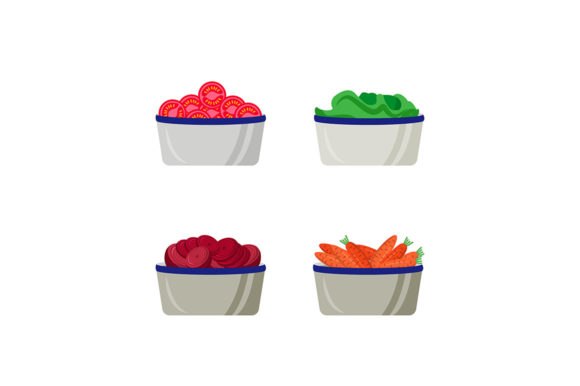
Why the Sliced Vegetables in Plates Flat Set is Essential for Modern Food Design
In the fast-paced world of digital content creation, the visual language of food has undergone a significant transformation. Gone are the days when only high-resolution, hyper-realistic photography could sell a recipe or promote a grocery delivery service. Today, there is a surging demand for clarity, speed, and stylistic consistency. This shift has placed assets like the Sliced Vegetables in Plates Flat Set at the forefront of modern graphic design workflows. These collections, often featuring raw salad ingredients in containers and isolated cartoon illustrations, are not just decorative elements; they are functional tools that bridge the gap between complex culinary concepts and instant user comprehension.
For professionals ranging from web developers to marketing entrepreneurs, understanding the utility of these vector object sets is crucial. The move toward flat design was initially driven by the need for responsive interfaces that load quickly on mobile devices. However, it has evolved into a preferred aesthetic for its ability to simplify information. When a user scans a meal prep app or a nutrition blog, they do not need to see the texture of every tomato seed immediately. They need to recognize the ingredient instantly. A well-designed flat icon set delivers this recognition without the visual noise that often accompanies detailed photography.
The Evolution of Culinary Illustration in Digital Media
The journey from realistic renderings to stylized vector graphics reflects broader changes in how we consume information. In the early days of the web, bandwidth limitations forced designers to use simple graphics. As technology advanced, high-definition images became the standard, leading to a period of visual excess. Recently, however, we have seen a pendulum swing back toward simplicity, driven by "banner blindness" and the overwhelming nature of modern media feeds. Users now crave clean, uncluttered visuals that communicate value propositions instantly.
This is where the Sliced vegetables in plates flat color vector object set becomes indispensable. These assets represent a mature stage in digital illustration where form follows function. By stripping away unnecessary shadows and gradients, flat designs focus the viewer's attention on the shape and color of the food item. This is particularly relevant for the grocery and health sectors. When displaying raw salad ingredients in containers, a flat illustration can standardize the appearance of diverse produce, making a chaotic assortment of vegetables look organized and appealing. This standardization helps build brand identity, as businesses can maintain a consistent color palette and line weight across all their marketing materials.
Furthermore, the rise of animation in web design has fueled the popularity of these isolated cartoon illustrations. Static images are increasingly being replaced by micro-interactions and motion graphics to engage users. A ZIP file containing EPS and JPG formats allows creators to take a static image of a sliced cucumber or a bowl of mixed greens and bring it to life. Whether it is a subtle bounce effect when a user adds an item to a cart or a looping animation explaining a recipe step, the scalability of vector files ensures that the quality remains crisp regardless of the screen size or motion complexity.
Practical Applications for Creators and Businesses
The versatility of a comprehensive vegetable plate set extends far beyond simple website decoration. For entrepreneurs launching food delivery startups or meal kit services, these graphics offer a cost-effective alternative to expensive food photography shoots. Photography requires styling, lighting, shooting, and editing, which can be prohibitively expensive for new ventures. In contrast, a high-quality vector set provides an immediate library of assets that can be customized to match specific brand colors. A marketer can easily recolor a bell pepper icon to match a seasonal campaign without needing to reshoot an entire product line.
Educators and content creators in the health and wellness space also benefit significantly. When creating infographics about nutrition, consistency is key. Using a mix of photos and clip art can look amateurish and disjointed. A unified set of grocery section isolated illustrations ensures that a chart comparing vitamin levels in different vegetables looks professional and cohesive. For bloggers, these assets improve page load speeds, a critical factor for SEO rankings. Large image files can slow down a site, frustrating users and hurting search visibility. Vector-based graphics, especially when optimized, are lightweight and render instantly, enhancing the overall user experience.
Consider the workflow of a freelance designer working on a mobile app for a grocery chain. The client needs icons for hundreds of products. Sourcing individual images is time-consuming and often results in inconsistent styles. By utilizing a curated collection of raw salad ingredients in containers, the designer can populate the app's interface rapidly. The isolation of these objects means they can be placed over any background color or pattern without unsightly white boxes or complex masking. This flexibility accelerates the design process, allowing freelancers to take on more projects and deliver higher value to their clients.
Meeting User Expectations in the Mobile-First Era
Modern users interact with content primarily through smartphones and tablets. This reality dictates design choices. Small screens require graphics that remain legible at reduced sizes. Detailed photographs often turn into muddy blobs when shrunk down to fit a mobile navigation bar or a push notification. Flat vector illustrations, by definition, rely on bold shapes and distinct colors, making them inherently more readable on small displays. The Sliced Vegetables in Plates Flat Set is engineered with this constraint in mind, ensuring that a slice of avocado is recognizable even as a tiny icon.
Beyond legibility, there is an emotional component to these illustrations. Cartoon-style graphics often evoke a sense of friendliness and approachability. For businesses trying to make healthy eating feel less intimidating or more fun, this tone is vital. A stark photo of raw kale might seem unappealing to some, but a cheerful, colorful illustration of kale in a bowl can invite engagement. This psychological nuance is a powerful tool for marketers aiming to change consumer habits. By presenting fresh produce in a playful, accessible format, brands can lower the barrier to entry for customers who might otherwise feel overwhelmed by complex dietary requirements.
Technical Advantages and Workflow Efficiency
From a technical standpoint, the format of these assets matters immensely. The inclusion of EPS (Encapsulated PostScript) files in a standard package is a game-changer for professionals. EPS is a vector format, meaning the image is defined by mathematical paths rather than pixels. This allows for infinite scalability. A designer can take a single vegetable icon from the set and blow it up to the size of a billboard without losing any resolution or sharpness. This future-proofs the investment, as the same asset can be used for a business card today and a large-format print ad tomorrow.
The accompanying JPG files serve a different but equally important purpose. They provide ready-to-use raster images for quick implementation in presentations, social media posts, or documents where vector editing software is not available. This dual-format approach caters to a wide range of users, from seasoned graphic designers using Adobe Illustrator to office managers creating internal newsletters in PowerPoint. The convenience of having both formats in a single ZIP file streamlines the asset management process, reducing the time spent searching for compatible file types.
Moreover, the isolated nature of these illustrations facilitates seamless integration into various design systems. In modern web development, components are often built to be modular. An isolated graphic can be dropped into a codebase and styled via CSS without interfering with surrounding elements. This modularity supports agile development practices, where designs need to be iterated upon quickly. If a brand decides to change its primary color scheme, the flat nature of these vectors makes global updates straightforward, ensuring brand consistency across thousands of pages with minimal effort.
Strategic Recommendations for Implementation
To maximize the value of a Sliced vegetables in plates flat color vector object set, creators should adopt a strategic approach to implementation. First, consider the context of use. While these graphics are versatile, they work best in environments that prioritize clarity and speed. They are ideal for instructional diagrams, app interfaces, and educational materials. Second, maintain consistency. Once you choose a specific style of flat illustration, stick with it throughout your project. Mixing different styles of flat art can create visual dissonance that undermines the professional look you are trying to achieve.
It is also advisable to customize the color palettes slightly to align with your specific brand guidelines. While the default colors in these sets are usually vibrant and appealing, tweaking them to match your corporate identity can strengthen brand recall. For instance, if your brand uses a specific shade of green for sustainability messaging, applying that exact hex code to the vegetable leaves in your illustrations creates a subtle but effective psychological link for the consumer.
Finally, do not underestimate the power of animation. Even simple movements can drastically increase engagement. Use the vector paths to create hover effects where vegetables slightly rotate or change color when a cursor passes over them. These micro-interactions make the digital experience feel alive and responsive, encouraging users to explore further. As web technologies continue to evolve, the line between static design and interactive experience blurs, and having assets that are ready for animation gives you a competitive edge.
In conclusion, the shift toward simplified, scalable, and engaging visuals is not a fleeting trend but a fundamental change in digital communication. The Sliced Vegetables in Plates Flat Set represents a convergence of artistic style and technical utility. For anyone involved in creating content related to food, health, or retail, these assets offer a practical solution to the challenges of modern design. They enable faster workflows, better user experiences, and stronger brand identities. By embracing these tools, professionals can focus less on the mechanics of image creation and more on the story they are telling, ultimately delivering more value to their audience in an increasingly crowded digital landscape.