Evaluating the Laboratory Equipment Flat Color Set for Digital Design
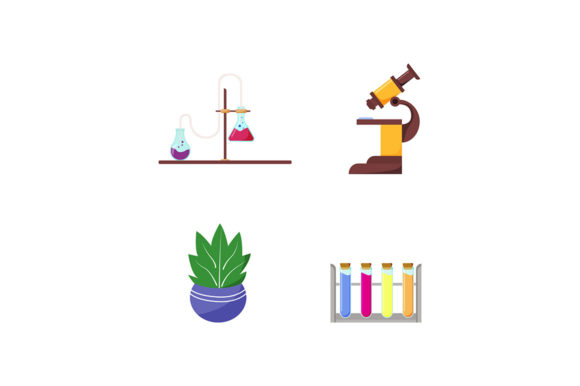
In the realm of scientific communication and educational web design, visual clarity is paramount. Designers and educators often face the challenge of representing complex laboratory environments without overwhelming the viewer with excessive detail or visual noise. This is where resources like the Laboratory Equipment Flat Color Set become valuable assets. This collection typically includes vector illustrations of essential chemistry tools, such as flasks with pipelines, microscopes for study, and various isolated cartoon-style objects designed specifically for web graphic design and animation.
Understanding the utility, limitations, and ideal applications of this specific type of asset library is crucial for anyone looking to enhance their digital projects. Whether you are developing an e-learning module, designing a website for a research institution, or creating animated explainers, evaluating whether a flat color vector set aligns with your goals requires a balanced look at its features and file formats, which often include EPS and JPG within a ZIP archive.
Defining the Asset Collection
The Laboratory Equipment Flat Color Set refers to a curated group of digital illustrations depicting standard scientific apparatus. Unlike photorealistic images or highly detailed 3D renders, these graphics utilize a "flat" design aesthetic. This style is characterized by clean lines, solid blocks of color, and a lack of three-dimensional effects like gradients, shadows, or textures. The inclusion of items like microscopes, test tubes, and piping systems allows designers to construct comprehensive scenes that immediately signal a scientific context to the audience.
These assets are usually provided as a laboratory equipment flat color vector object set. The vector format (often EPS) is significant because it allows the graphics to be scaled infinitely without losing quality. This makes them suitable for everything from small mobile icons to large desktop banners. The accompanying JPG files offer ready-to-use raster versions for quick implementation, while the ZIP file structure ensures all components are organized for easy download and integration into design software.
Strategic Benefits for Web and Animation
There are several compelling reasons why a designer might choose this specific style of illustration over other options. The primary advantage lies in versatility and performance. Flat designs generally result in smaller file sizes compared to high-resolution photography or complex 3D models. For web graphic design, this translates to faster page load times, which is a critical factor for user experience and search engine optimization.
Furthermore, the isolated nature of the chemistry tools isolated cartoon illustration elements provides maximum flexibility. Because each item—be it a flask or a microscope—is separated from the background, designers can easily rearrange them to create custom layouts. This modularity is particularly beneficial for animation collections. When preparing assets for motion graphics, having distinct layers and clean outlines simplifies the rigging and keyframing process, allowing for smooth transitions and engaging educational content.
The aesthetic consistency of a flat color set also helps in establishing a cohesive brand identity. By using a unified color palette and line weight across all scientific instruments, projects maintain a professional and organized appearance. This is especially important in educational materials where cognitive load must be managed; simple, clear visuals help learners focus on the concepts rather than deciphering complicated imagery.
Considerations and Tradeoffs
While the benefits are notable, it is important to acknowledge the tradeoffs associated with using a Laboratory Equipment Flat Color Set. The stylized, cartoon-like nature of these illustrations means they may not be appropriate for every context. For example, high-level academic journals or technical manuals requiring precise anatomical or mechanical accuracy might find flat vectors too abstract. In situations where exact proportions, material textures, or lighting conditions are critical for understanding the equipment's function, photorealistic imagery or detailed technical drawings remain the superior choice.
Additionally, the "cartoon" descriptor implies a certain level of simplification. While this aids in general comprehension, it can sometimes strip away nuance. A flask with a pipeline in a flat design might omit specific valve types or connection standards that would be visible in a photograph. Designers must evaluate whether the level of abstraction serves their narrative or if it risks oversimplifying the subject matter to the point of inaccuracy.
Another consideration is the customization effort required. Although vector files are editable, modifying a pre-made set to match a specific corporate color scheme or to add intricate details can be time-consuming if the original layer structure is not well-organized. Users should verify the quality of the EPS files within the ZIP package to ensure that paths are closed and groups are logical before committing to the asset for a large-scale project.
Ideal Use Cases
This type of asset library is a strong fit for several specific scenarios. It excels in e-learning platforms targeting K-12 or undergraduate students, where engagement and clarity are prioritized over granular technical detail. The friendly, approachable look of cartoon illustrations can make intimidating scientific topics feel more accessible.
It is also highly effective for infographics and data visualization. When illustrating a workflow in a chemical plant or the steps of an experiment, flat icons serve as excellent markers that guide the eye without distracting from the data. Marketing materials for biotech startups or science museums also benefit from this style, as it conveys innovation and modernity without the sterile feel of stock photography.
For animation projects, such as explainer videos on YouTube or internal training modules, the clean lines of flat vectors facilitate smoother motion. The lack of complex shading means that animators do not have to worry about light sources shifting unnaturally as objects move, streamlining the production pipeline.
When to Consider Alternatives
Conversely, there are situations where alternatives may be worth considering. If the target audience consists of industry professionals, engineers, or researchers who require strict adherence to ISO standards for equipment representation, a flat color set may appear too informal. In these cases, CAD drawings or high-fidelity 3D renders would be more appropriate.
Similarly, if the project demands a moody, atmospheric, or highly realistic tone—such as a documentary website or a serious news feature—the bright, solid colors of a flat set might clash with the desired emotional impact. Here, curated photography or cinematic rendering would better support the narrative gravity.
Making the Decision
Selecting the right visual assets ultimately depends on the intersection of your audience, medium, and message. When evaluating the Laboratory Equipment Flat Color Set, ask yourself if the priority is speed, scalability, and approachability. If your goal is to create lightweight, adaptable, and visually consistent graphics for the web or animation, this vector object set offers a robust solution.
However, always review the sample files, specifically checking the EPS integrity and the range of objects included. Ensure that the specific tools you need, such as the microscope or specific pipeline configurations, are present and styled in a way that complements your existing design language. By balancing the need for aesthetic appeal with the requirement for informational accuracy, you can determine if this collection is the right foundation for your next scientific design project.